
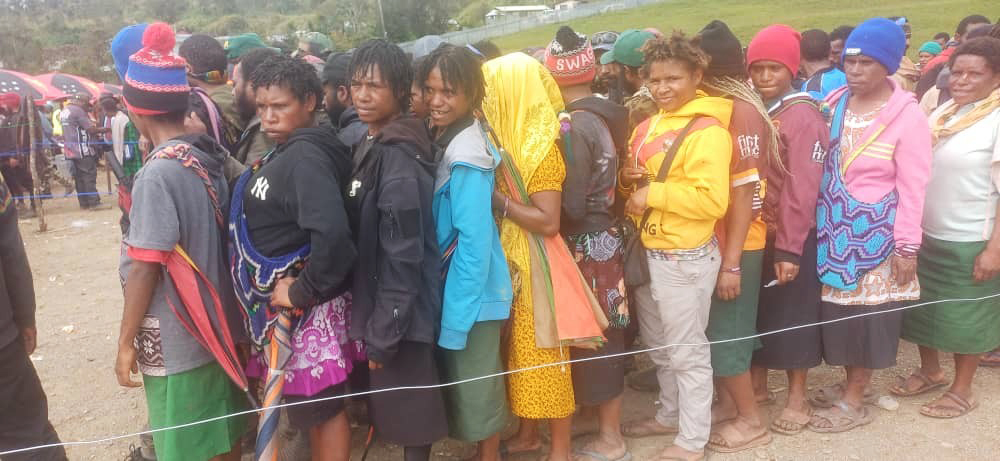
Wilson Thompson shares his perspective on election integrity in Papua New Guinea.
By Wilson Thompson
Prime Minister James Marape has announced that by the 2027 National Elections, Papua New Guinea will implement a biometric voting system supported by the Civil Registry Project. What has eluded policymakers is that civil registry and common roll systems must originate from village-level data collection — specifically from Ward Rolls or Tax Rolls extracted from Village Record Books. Why are we avoiding the source information at village and suburb levels and working backwards, when we should be building upwards from local data?
The integrity of our elections and national leaders is under serious question. The 2022 general election was described as the most violent in PNG’s 47 years of independence, with over 102 election petitions lodged in the Court of Disputed Returns. This represents an unprecedented challenge to electoral legitimacy, with most disputes related to bribery, corruption, common roll defects and the general conduct of polling and counting. When nearly every seat in Parliament faces legal challenges, we must raise concerns about the integrity of our Members of Parliament and the electoral systems themselves. This is a frightening revelation, and the Prime Minister, Government and Opposition must support the Department of Provincial and Local Level Government (LLG) Affairs and the Electoral Commission to review the election process and electoral systems to make them secure and free from interference, enabling eligible voters to cast their votes.
Often, PNG records are not held even in our National Library and National Archives or other responsible agencies, including the Electoral Commission. PNG has cried foul over elections, high costs of common roll updates, deferred National Census and LLG Elections and blown-out Civil Registration costs. Yet the solution has been staring us in the face all along. If we had simply asked what was needed, we would recognize the historical system: the Village Book that generated the Tax Roll and Ward Roll (which became the Common Roll), while the Patrol Box evolved into the Ballot Box, along with the Annual District Reports. The Australian colonial administration used this system to maintain accurate Head Tax and Property Tax Rolls. The Ward Roll, extracted from Village Books, became the Common Roll for elections. This system worked because it started with accurate village-level information and built upwards.
All records started as Village Books, with data extracted for official records such as birth, marriage, adoption and death certificates, as well as Ward and LLG Rolls for tax and election purposes. From the Village Book, various certificates and statistics were reported. From the Village Book, Head Tax was applied and records of employed or unemployed were produced. Civil Registry records captured details of father and mother, occupation and date of birth. When you marry or die, another certificate is issued. This was the foundation that made the whole system work.
Instead of continuing with this proven approach, we are trying to trim the Civil Registration and Common Roll and Public Service file numbers and property files that have grown out of proportion and confused everyone. We’re working backwards from a broken system instead of rebuilding the foundation. Let’s cut off fancy technological solutions and look at what actually works: comprehensive data that can be shifted from one location to another and transported effectively, starting from the village level and shared with many users. Fixing the Common Roll alone will not fix our data and planning challenges.
The Department of Provincial and Local Government Affairs (DPLGA), as successor to the Department of Development Administration and Native Affairs and later Department of District Administration, has the mandate to fix this. In the past, it collected village records through patrol officers. Now, the system has evolved to include Ward Recorders in 6,000 wards, LLG Officers in 300 LLGs and District Officers in 93 districts, creating a more comprehensive network for data collection. DPLGA has overarching legislative oversight through the Organic Law on Provincial and Local-Level Government (OLPLLG) and also the Provincial Government Administration Act, LLG Administration Act and National Statistical Act. It has the mandate to collate the Village Book that forms the Ward and LLG Roll and becomes the Common Roll used by the PNG Electoral Commission (PNGEC).
If DPLGA adopts this village-based approach, it could cost less than K50 million to develop, collate and maintain a village, ward, LLG, district, provincial and national database. The K50 million estimate includes current wages or allowances for ward recorders as well as additional costs or laptops and Village Book hardcopies as the base from which information is copied into laptops and transmitted to LLG, District, and Province offices for certification to DPLGA. It also includes funding for central data building and data collection facilities. The balance covers software development and validation of data by one-off research assistants and data recorders, plus mop-up operations to ensure complete coverage.
Compare this to the PNGEC, which requests over K50 million just to update Common Rolls without having the comprehensive staffing network or administrative authority that DPLGA possesses.
We need country-wide data that can be used by everyone — and that foundation is the Village or Ward Record Book. As the neutral department with oversight of multi-functional responsibilities, DPLGA would enable the Department of Information and Communication Technology (DICT), PNG Civil and Identity Registry (PNGCIR), PNGEC, Internal Revenue Commission, Immigration and Citizenship Services, National Department of Education, National Department of Health, and Department of Higher Education, Research, Science and Technology and Internal Revenue Commission to access data for their planning and use.
The merit of this system is its simplicity and effectiveness. Every year, Ward Recorders would submit names of those turning 18 and record deaths. When you move to school, work, or live in another village, suburb, or ward, you are transferred to the new Ward Book. Simple bottom-up data collation and upscaling provides better visibility than our current confused approach.
Penalties and rewards through grants, wages and salaries of Ward Recorders and Village Court Clerks would ensure accurate certification and compliance. LLG Officers and District Officers would provide quality control and oversight. Public servants can achieve cost savings, better resource use and one-stop service delivery. The PNGEC, National Statistical Office, PNGCIR and DICT does not have staff capacity in all LLGs and Districts.
For rural areas and isolated communities, the Ward Recorder and Village Book is the central foundation of the total system and should be immediately integrated as the basis for inputting data held by Government institutions. The Government must ensure that biometric fingerprinting and photographic electoral rolls become a reality through the Village Book system. This must be a whole-of-government approach that connects civil registry, IRC tax records, public service payroll, education enrolments, land titles, vehicle registration and licensing, as well as births recorded at all health facilities.
Countries like India have successfully implemented biometric voting for over 800 million voters, but their success was built on robust foundational data systems, not merely technology deployment. Once we get the foundation right, data can be used by anyone, and PNG can achieve the Prime Minister’s vision of biometric voting while creating a comprehensive civil registry system that serves citizens effectively.
The Government should ensure that biometric fingerprinting and photographic electoral rolls become mandatory for the 2027 elections. PNG’s democratic future depends on building robust electoral systems from the ground up rather than pursuing technological solutions without proper foundations. We must invest in village-level data collection that made our historical electoral systems functional.
The 2027 elections are not far away. If we begin implementing village-based data systems immediately, we can still make this work. The choice is clear: we can continue with expensive, top-down solutions that fail to address fundamental data quality issues, or we can return to the proven approach of building reliable national systems on accurate local foundations.
About the Author
Wilson Thompson served in Papua New Guinea’s public service in various senior roles since 1995. He is currently Chairman of the PNG National Research Institute.
This article was originally published in the ANU DevPolicyBlog.




 The New Atoll
Leave a comment